
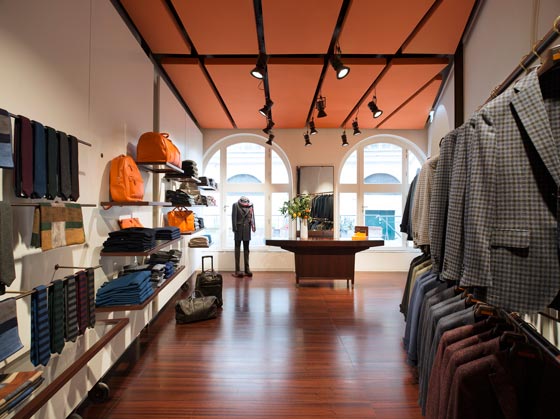
A renewed identity for a historic Roman store
With the intervention of Alvisi Kirimoto, the historic Davide Cenci store in Rome rediscovers the balance between its long-standing tradition and its modern soul. The project involves a retail space of over one thousand square meters in the heart of the city, near the Pantheon and the Chamber of Deputies, in the Campus Martius district. The double-height flagship, relaunched during the presentation of the new fragrance and the “Since 1926” collection — designed and produced in-house — has undergone a partial restoration.
The restyling and architectural design were entrusted to Alvisi Kirimoto, who also designed the Davide Cenci Jr store opened in 2012 in the nearby Campus Martius. David and James Cenci commissioned the completion of the renovation of the ground floor, originally started in 2002 by New York–based studio Gabellini Sheppard Associates. The project includes the transformation of the historic tailoring area into a new space dedicated to fragrances, bags, accessories, and the brand’s men’s collection, reinforcing their commitment to retail design.
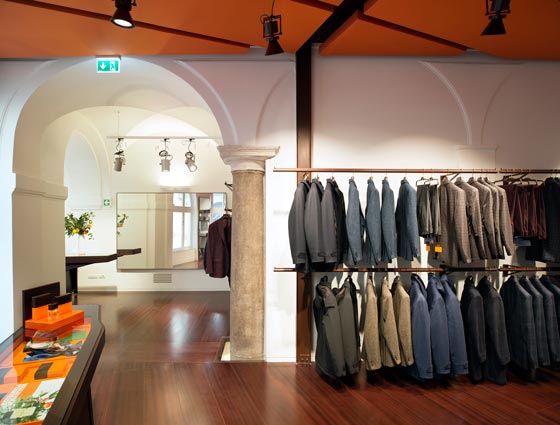
A design concept rooted in simplicity and brand identity
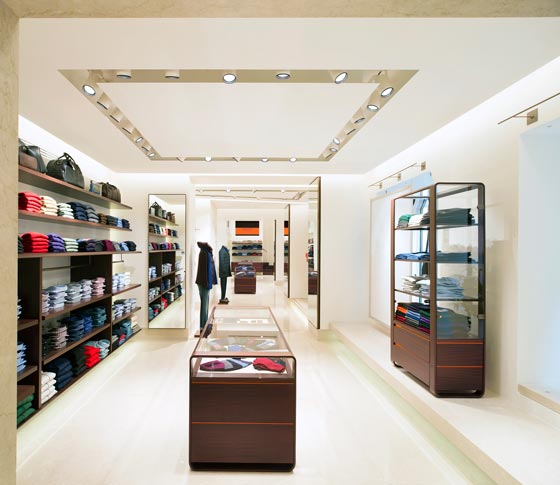
The project is based on a simple and functional interior design approach reflecting the brand’s core values: tradition and innovation. Modern materials were selected and paired with restored furnishings, placed within an environment where fine woods and carefully chosen colors frame the “Since 1926” collection and the new fragrances.
A dialogue between historical memory and contemporary sensitivity
Junko Kirimoto interpreted the spaces by weaving together historical memory and contemporary sensibility, explaining: “We immediately embraced the idea that the completion of the ground-floor space should follow the style and appearance of the entire store: tradition and innovation, clean lines, simple elegance enhanced by noble materials such as Roman botticino and mahogany. Our goal was to let the rooms speak through their material qualities rather than through classical ornamentation. We removed as much as possible, allowing the walls of this historic building to breathe, eliminating decoration and enhancing the structure.”
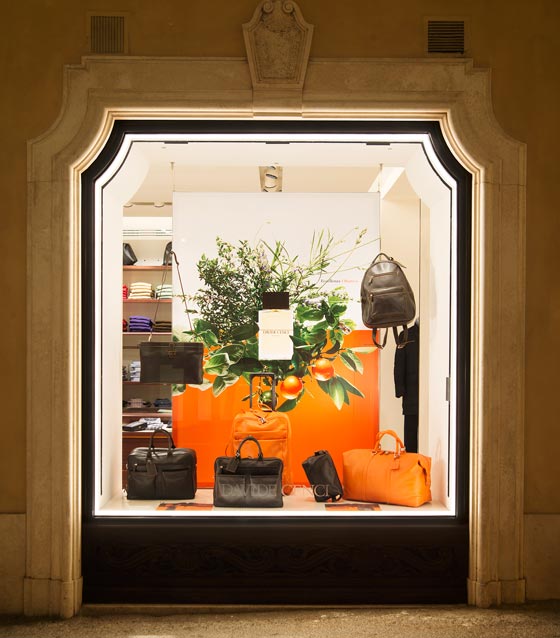
A renewed window display and the transformation of the tailoring room
One of the highlights of the store is the window display. Junko Kirimoto adds: “We are extremely pleased that, together with David and Giacomo Cenci, we decided to transform the windows into a threshold between the street and the store. On one side, we kept the original travertine frames; on the other, we opened the interior to showcase the collections in a museum-like setting enriched by traces of the past, including an ancient Roman column.”
“The most exciting and challenging part of the project was the old tailor’s workshop, which had become too small and needed to be reimagined. The space retains its ‘workplace’ character with exposed steel beams, wooden floors, large display units, and ceiling panels made of orange fabric — echoing the spools and threads once used by tailors. These textile elements also contribute to a calm and peaceful atmosphere. Overall, the intervention defines a dynamic yet informal area that, through the store, opens visually onto the courtyard.”
Studio Alvisi Kirimoto
After ten years of collaboration with architects such as Renzo Piano, Massimiliano Fuksas, and Oscar Niemeyer, Massimo Alvisi and Junko Kirimoto founded the architecture practice Alvisi Kirimoto in 2002. Their major works include the Giovanni and Paolo Bulgari winery in San Casciano dei Bagni (Siena), the new office building for Molino Casillo (Puglia), the interiors of the Aleksandrinsky Theatre in Saint Petersburg, the Theatre of the Academy of Fine Arts in Naples, the Corato Theatre (Bari), and the Incà industrial complex in Barletta.
Other projects include a new hotel in Dalmine (Bergamo), a residential building in Trani, temporary pavilions for the Rome Film Festival, the Hamasei Japanese restaurant in Rome, and the Davide Cenci stores in Rome and Milan. Among their exhibition designs are the Aristaios Museum, “Il silenzio a colori” by Michelangelo Antonioni, the permanent MUSA Museum for musical instruments at the Accademia di Santa Cecilia in Rome, and Salt Expo in Naples.
Photos courtesy: Anna Galante
by AN Shopfitting Magazine no.131 ©