
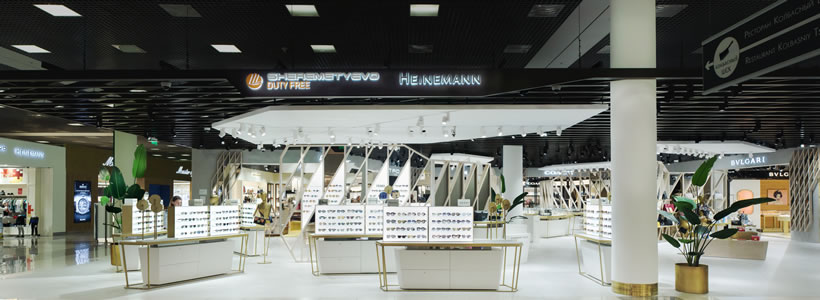
At Sheremetyevo International Airport in Moscow, an 830 sqm multibrand store designed by plajer & franz studio translates the atmosphere of a department store into a travel retail environment. Operated by Gebr. Heinemann, the space brings fashion, accessories, watches and jewellery together within an open layout conceived to maintain visibility across the different brand areas.
Rather than organising the store as a sequence of enclosed boutiques, the project combines personalised brand spaces with a shared architectural framework. Three wall boutiques are arranged around a central area, while open displays and flexible presentation zones allow travellers to move freely through the store.
An open layout for travel retail
The design responds to the specific conditions of an airport environment, where orientation, visibility and circulation are essential. High ceilings and wide aisles establish clear sightlines across the store, while suspended ceiling elements and permeable display structures help define individual areas without creating rigid visual barriers.
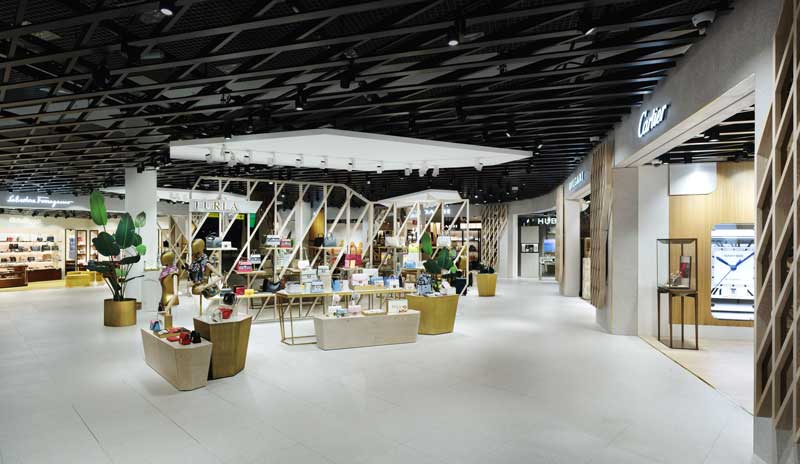
Beyond the main circulation routes, the layout introduces spaces where travellers can browse the different product categories in a less linear way. The result combines the operational requirements of travel retail with the spatial organisation of a department store.
The Fabergé egg as a design reference
One of the defining elements of the project is its connection with Moscow and Russian decorative culture. The design takes inspiration from the faceted geometry of the Fabergé egg, using its diamond-shaped pattern as a recurring architectural motif.
The geometry appears at different scales throughout the interior, from partition walls and façades to ceiling structures, furniture and point-of-sale elements. Rather than functioning as a decorative addition, the motif provides a common visual language capable of connecting the individual brand areas.
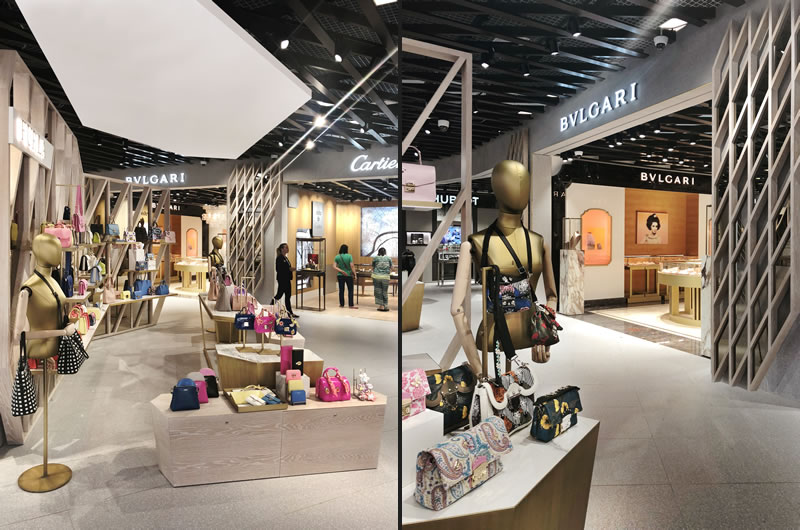
Whitened oak and brass are combined with terrazzo and marble, establishing a material palette that reinforces the geometric character of the interior while differentiating surfaces and display elements.
Flexible displays and personalised brand areas
The 830 sqm store is organised around personalised brand spaces positioned along a large open central zone. Four freestanding areas provide flexible platforms for changing brand presentations.
Diamond-shaped ceiling canopies identify these areas from a distance and contribute to orientation within the store. Below them, bespoke display furniture uses lightweight structures and transparent or permeable elements to preserve visual continuity.
Rhombic timber frameworks partially enclose the different zones without completely separating them from the surrounding space. Display cases and point-of-sale elements are arranged on diamond-shaped tables with slender brass frames and tabletops in terrazzo, marble or wood.
Storage is integrated below or around the display tables, allowing the furniture to combine presentation and operational functions without introducing additional visual clutter.
A shared identity for multiple luxury brands
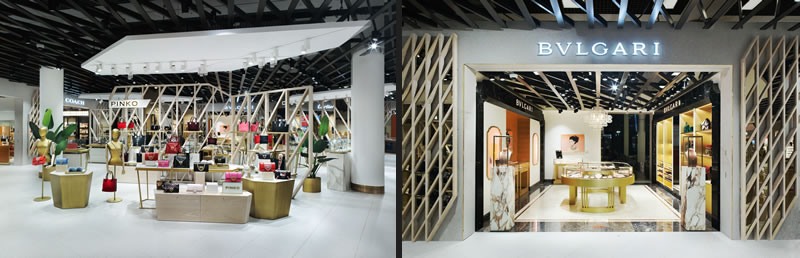
The architectural system provides a common setting for brands including Cartier, Coach, Furla, MCM, Ferragamo, Tumi, Bulgari, Montblanc, Etro and Pinko.
The project addresses one of the central challenges of multibrand retail: maintaining the individual identity of each label while giving the overall store a recognisable spatial character. Here, the recurring geometry, material palette and open circulation system act as the elements that connect the different branded environments.
Project: Multibrand Store for Travel Retail
Location: Sheremetyevo International Airport, Moscow, Russia
Area: 830 sqm
Store design & concept: plajer & franz studio
Shopfitting: Dula International
Photography: © Imperial Duty Free