

In contemporary retail, the experience also depends on what often remains “invisible”: the micro-devices that organize the product narrative. Price tags, size markers, sign holders, small acrylic displays: minute elements, yet decisive, because they define informational hierarchies, visual clarity, and the rhythm of the layout. This is where Salviplast focuses an increasingly recognizable part of its research, developing point-of-sale solutions designed to be technical, lightweight, and consistent with the brand’s identity.
At the core of this production is a fully Made in Italy range dedicated to visual merchandising, conceived to adapt to different product categories and constantly evolving display layouts. The logic is modularity: components that can be assembled, updated, and reconfigured to support collection changes, promotions, and display recalibrations without compromising readability or visual consistency.
Acrylic and precision in visual merchandising
Acrylic, in this context, is not a neutral material. It is a curatorial choice: controlled transparency, calibrated thicknesses, edges, and folds that turn the support into a “silent” element, capable of enhancing the product without interference.
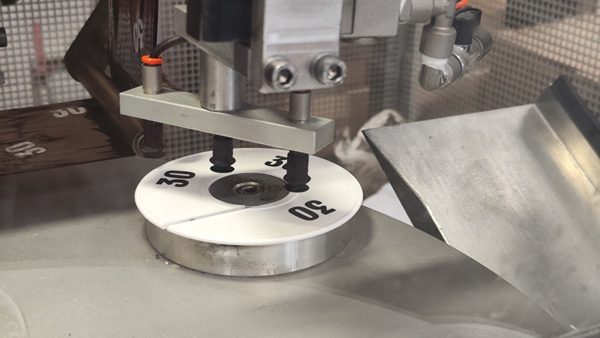
Processes such as laser cutting and engraving, together with heat bending, make it possible to define precise geometries and clean details. This becomes particularly relevant when store lighting—especially near shop windows and display cases—makes every finish and every edge clearly visible.
Customization and visual identity at the point of sale
Alongside the functional dimension is an identity-driven one. The possibility of customizing supports with lettering, logos, and graphic signs through laser marking allows even the most technical elements to align with the brand’s visual language.
In a landscape where brand consistency is measured through details, customization is not an embellishment but an operational requirement. In this way, continuity can be maintained between the shop window, the sales area, and dedicated corners, strengthening the overall legibility of the customer journey.
Finishes and material perception in retail displays
A further layer is provided by finishes. Gloss, matte, and soft-touch coatings, together with special effects and decorative processes, open the way to solutions that expand the use of thermoplastic materials in retail.
Tactile surfaces, controlled colors, and textures become design tools when the stand, corner, or display must interact with the store’s interior, materials, and lighting concept. In this scenario, even a technical element such as a sign holder contributes to the construction of the commercial environment.

From industry to the micro-architecture of display
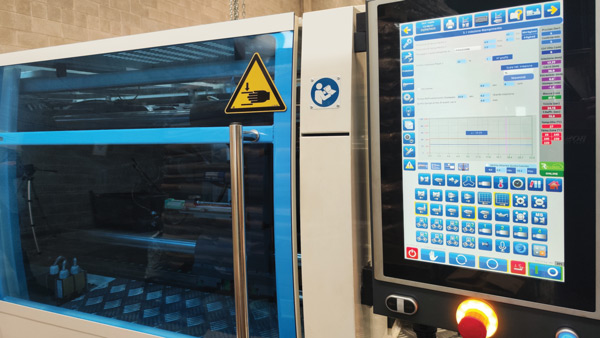
This retail focus does not emerge in isolation, but is grounded in a consolidated industrial framework. Salviplast has operated since 1979 in the injection molding of thermoplastic materials and mold construction: a background that translates into supply chain control, attention to tolerances, and reliability of the finished product.
The culture of mold-making—the ability to govern form at its source—thus becomes a concrete advantage for the point of sale as well, where robustness, repeatability, and finish quality must withstand daily use and time pressure.
A coherent continuity is therefore established: from the industrial matrix to the micro-architecture of display. The result is a set of tools designed to work effectively within retail space, endure over time, and be easily updated, while maintaining the formal restraint that allows the display to leave the product in the foreground.
Salviplast at EuroShop: dialogue between industry and design
Within the context of EuroShop Düsseldorf, this evolution found a natural stage. During the edition of the trade fair that closed on February 26, Salviplast presented an approach that connects manufacturing expertise with attention to visual merchandising.
The company’s presence at the fair showed how even small-scale components—price tags, sign holders, and display supports—can become design tools capable of improving the organization of retail space. In this dialogue between industry and design, every detail contributes to building a clearer, more orderly, and more coherent shopping experience aligned with the identity of the point of sale.
by AN Shopfitting Magazine no.191 ©