

Neurodesign applied to pharmacy design uses principles of neuroscience, behavioral psychology and spatial design to influence customer perception, emotions and behavior.
Design experiences that anticipate your customers’ choices
Have you ever truly considered what happens in your customer’s mind in the very first moments he enters your pharmacy? Not when he stops in front of a product, not when he speaks with you or a staff member, but before, when he has not yet made any apparent choice.
This question is far more strategic than it seems because it’s not the customer who chooses the space: it’s the space that influences the customer.
So you should be asking yourself:
What does your pharmacy really communicate? Which emotions does it evoke? What kind of experience is it generating, consciously or not? And above all: does the pharmacy you have today support the customer’s choices or does it hinder them without you realizing it?
At EXELVIA we work every day with this awareness: customers do not decide with logic, or at least not at first. Most decisions happen automatically, unconsciously, often instinctively.
This is supported by Robert Cialdini, the U.S. psychologist considered the world’s leading expert on persuasion, who explains in his book Pre-Suasion how context influences a choice even before a person begins to think about it. Practically speaking, your furnishings, your window displays, your lighting, your entrance, your colors are already speaking to the customer long before you or your team can do it.
Daniel Ariely, behavioral economist and author of Predictably Irrational, shows that most decisions come from mental shortcuts and automatic rules that the brain uses to save energy. The customer thinks he is deciding rationally, but his mind has made the decision long before him.
Martin Lindstrom, in his bestseller Buyology, demonstrates how visual stimuli, scents, sounds and materials trigger immediate emotional responses which influence perceptions and preferences. In other words: customer behavior is profoundly sensory.
If these are the scientific foundations, the question you should be asking is: Is your pharmacy exploiting these mechanisms or is it being subjected to them? And if it is, how much revenue are you unknowingly losing?
This is where Neurodesign comes from.
And this is where the EXELVIA method is born.
1. The automatic response: body decides before mind
Next time you walk into your pharmacy, try this small exercise: stop at the entrance and ask yourself how the space makes you feel in the first three seconds. No more. Three.
Is it calm or chaotic? Does it welcome you or push you away? Does it give you clarity or confuse you? Your customers are living that same feeling every day. And that feeling influences everything that happens afterward.
Cialdini defines this process as “pre-suasion”: the predisposition that the context creates before the decision.
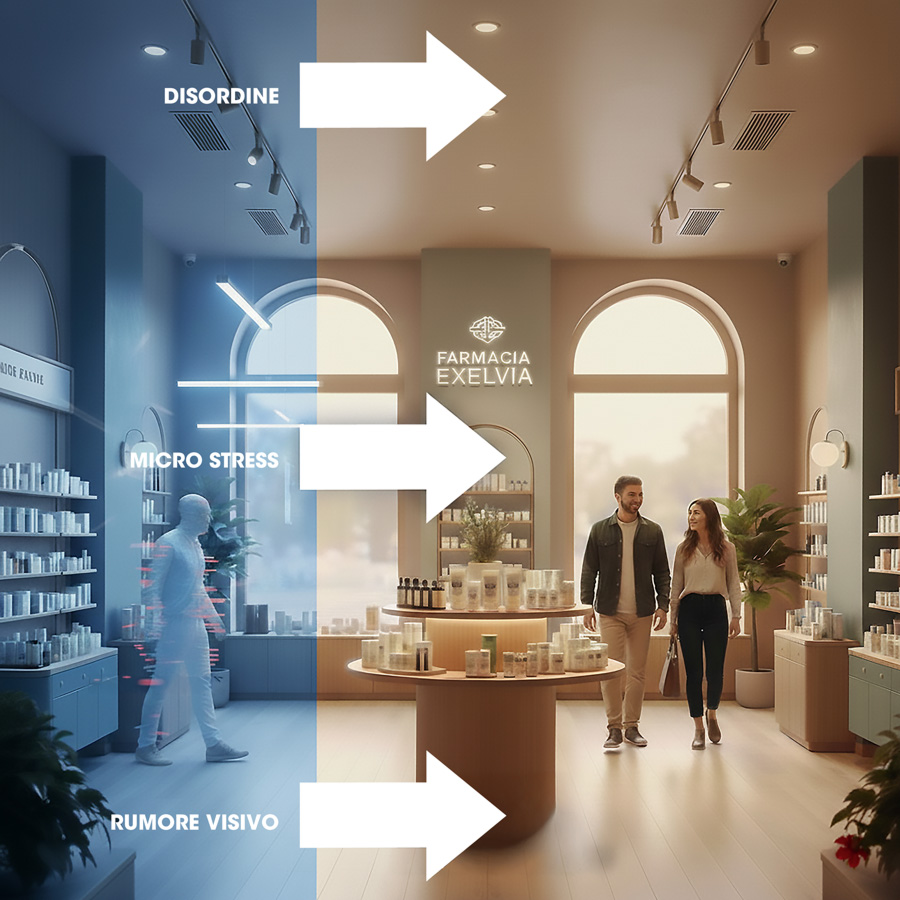
If your entrance communicates disorder, crowding, visual noise, the customer’s brain activates a defense mechanism. Space becomes stressful. But if the space is bright, clean, readable, harmonious, the customer opens up, relaxes and lets himself be guided.
Key question: Is the first impact of your pharmacy encouraging the customer to stay… or to leave as soon as possible?
2. Instinctive mapping: brain recognizes, it doesn’t search
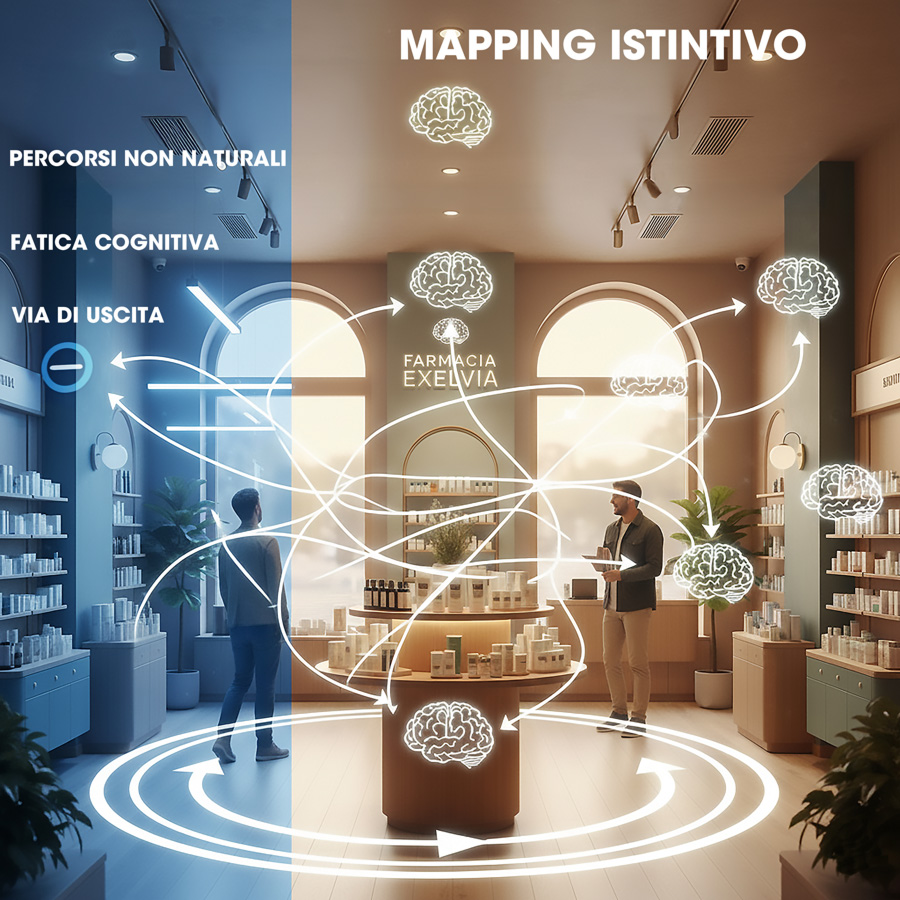
Ariely has shown that the human brain avoids cognitive effort: if an environment is unclear, the brain gets tired. And when it gets tired, it looks for a way out.
For this reason, the customer doesn’t want “to look” for what he needs: he wants to recognize it. And if he doesn’t recognize it, he interrupts his path.
Now ask yourself:
Is your pharmacy easy to read? Can the customer orient himself alone? Does he know where to go without asking for help? Or does he get confused even with the simplest actions?
A layout designed according to Neurodesign respects the person’s spontaneous mental maps: open entrances, natural pathways, clear landmarks, visual logic that mirrors the way the brain organizes information.
When this happens, the customer moves smoothly, explores longer, looks at more products.
When it doesn’t, he gets stuck, stressed, he gives up.
And you, in your pharmacy, would you recognize an intuitive path? And above all: would your customer recognize it?
3. Sensory triggers: decision is driven by the senses, not by logic
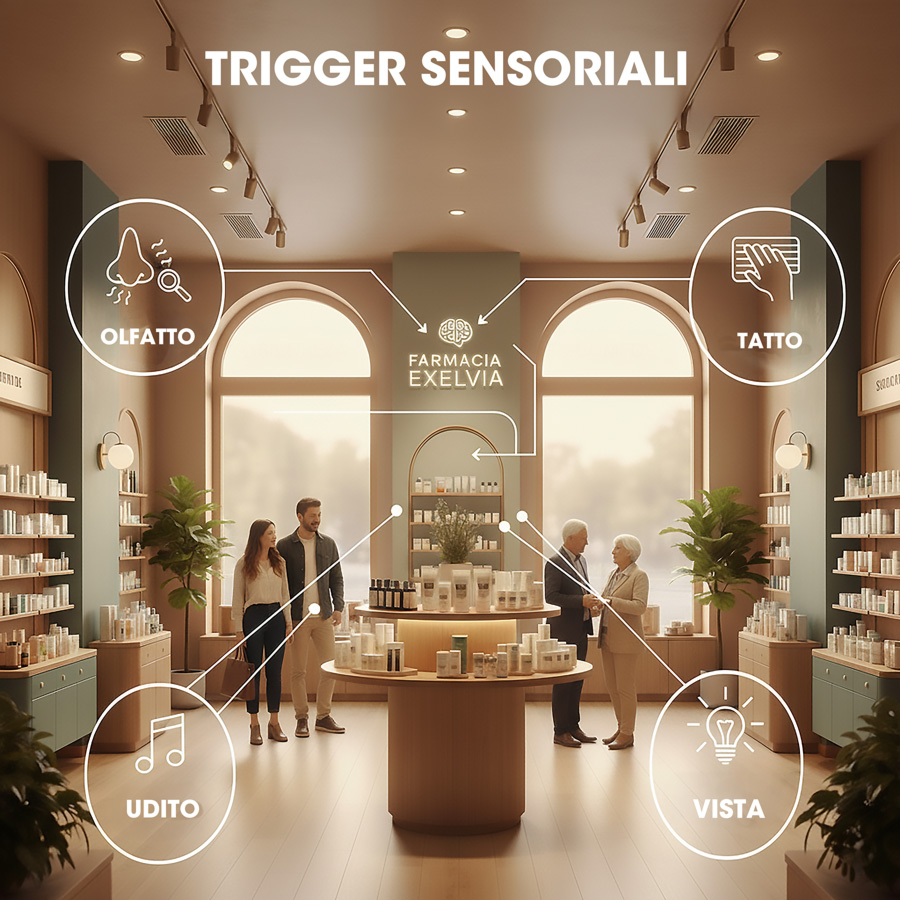
Lindstrom has shown how the sensory system influences memory, perception and even the perceived value of products. This means that every sensation experienced by the customer inside your pharmacy is a message.
Not an aesthetic message: a neurological message.
Try to ask yourself: What feeling does the lighting in your pharmacy evoke? Is it an invitation or a limitation? Is the scent neutral, pleasant or absent? Do the materials convey quality or coldness? If there is music, does it create atmosphere or is it distracting?
Every sensory detail guides behavior:
- A citrus scent communicates cleanliness and energy.
- A natural texture communicates trust and warmth.
- A slow music extends the stay.
- An accent lighting guides the gaze wherever you want.
The customer does not consciously formulate these considerations, but his brain does. And his own brain decides.
The real question is: What invisible messages is your pharmacy sending to your customers today?
4. Cognitive biases: the shortcuts that guide choices
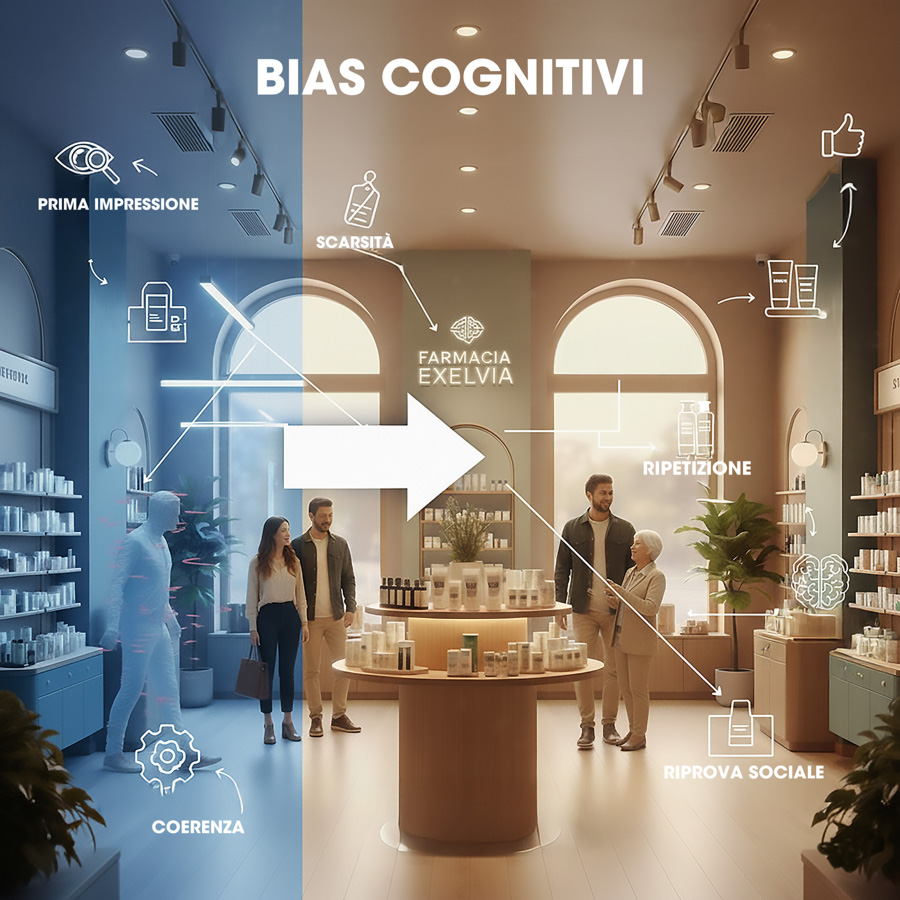
Ariely defines cognitive biases as shortcuts that the brain uses to speed up decisions. They are automatic, inevitable, extremely powerful. The good news is that a smart layout can integrate them ethically to create a better experience.
Ask yourself: What is the first image the customer sees upon entering? What is the second one? And the last one? Which products does he see most often as he walks? The most relevant ones or those placed there by chance?
The first impression sets the emotional standard for the entire visit.
- Scarcity makes a product more desirable.
- Repetition creates preference.
- Consistency between message and environment generates immediate trust.
- Social proof makes a product more reliable.
- Does your space today leverage these natural shortcuts… or does it hinder them?
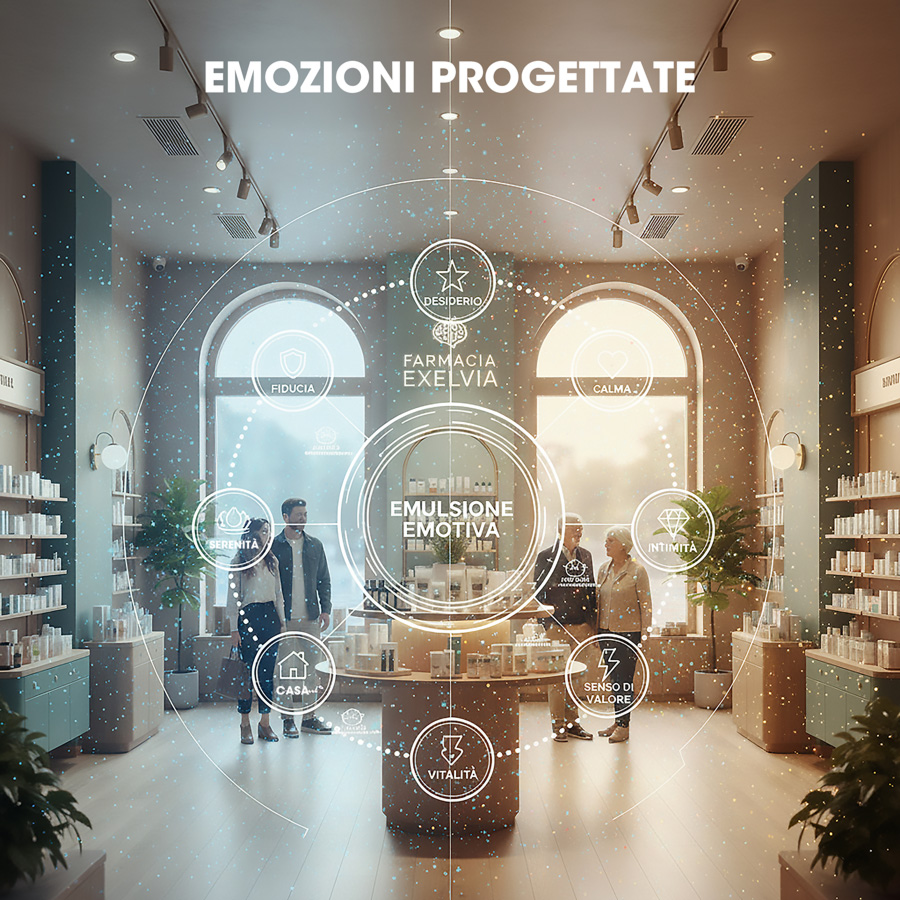
5. Designed emotions: customer feels before he understands
Every choice comes from an emotion.
No matter how rational a customer may seem: what drives his action is the immediate feeling experienced in the space. Neurodesign works precisely on this deep, non-decorative level.
EXELVIA speaks of an “emotional emulsion” to describe the blend of emotions intentionally designed for each area: safety in the wellness area, precision in the tech area, softness in the mother-and-child zone, playfulness in the kids’ corner, clarity and rigor in the services section.
Ask yourself:
Do the emotions that your pharmacy evokes today match the ones you want it to evoke? Or is the space communicating something different from what you intend to communicate?
6. Memory and anchoring: customer returns because of how he felt
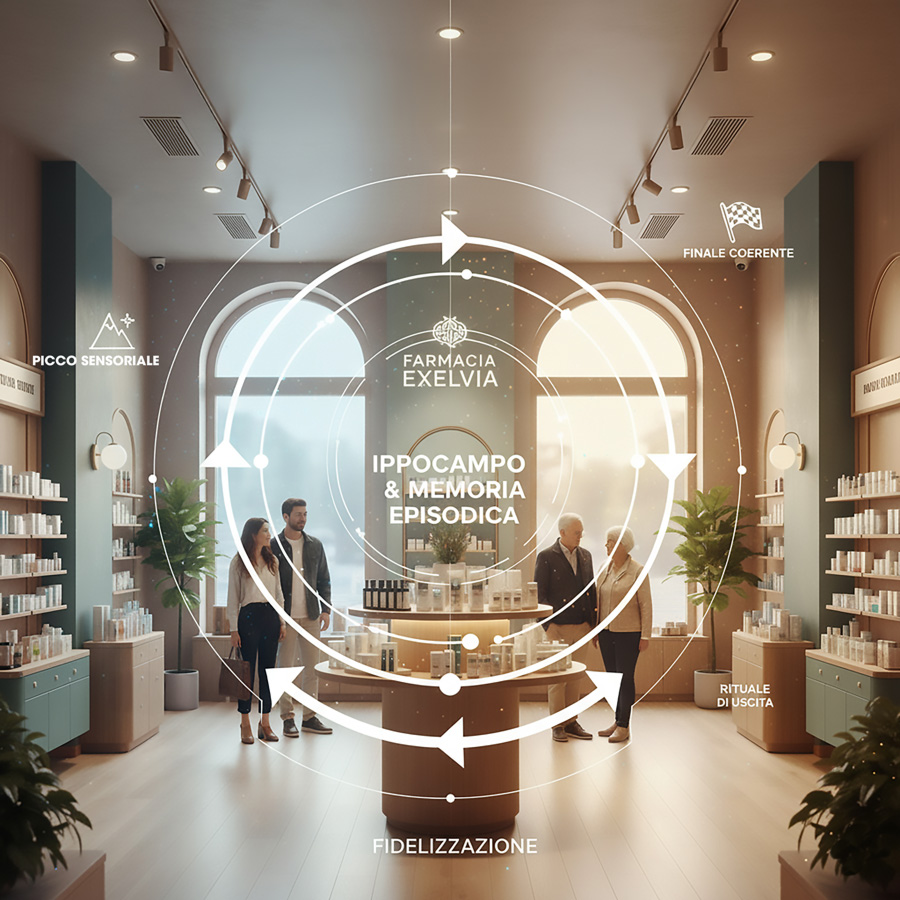
Daniel Kahneman, Nobel Prize in Economics, described the Peak-End Rule: we primarily remember two moments of an experience. The emotional peak. The ending. Everything else fades.
Ask yourself: What is the “wow moment” of your pharmacy? And what is the final moment that accompanies the customer towards the exit?
EXELVIA deliberately designs both these elements: a distinctive sensory peak that makes the experience memorable and a coherent ending that leaves a sense of order, care and professionalism. It is this that determines the memory. And it is memory which drives people to return.
7. Adaptive neurodesign: spaces which learn from the customer
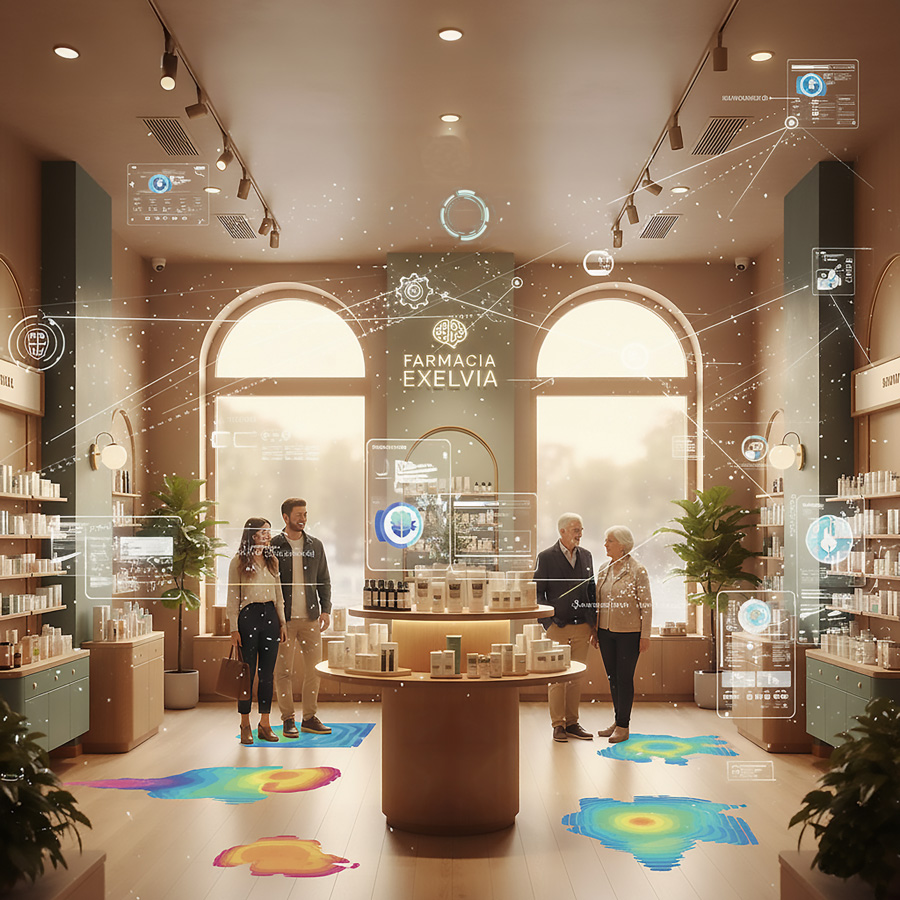
Pharmacies are no longer just static spaces: they are becoming intelligent organisms. Behavioral heatmaps, sensors, dynamic lighting, focal points that adapt to customer flows: everything serves to build an experience evolving constantly.
Now ask yourself: Is your pharmacy learning from customers? Or is it stuck in a model that no longer responds to real human behaviors?
A space that observes, analyzes and adapts is a space that sells. A static space, however beautiful, is no longer enough.
Conclusion: Neurodesign is strategy, not aesthetics
Neurodesign is a scientific framework that allows the creation of spaces capable of influencing real behaviors. It is not an aesthetic approach, but a strategic one. It guides the customer, reassures him, engages him, makes him return.
EXELVIA applies it through a multidisciplinary method integrating neuroscience, coaching, strategic consulting and purchasing experience, to transform the pharmacy into a place that works, communicates, converts and builds loyalty.
The real question is: Is the pharmacy you have today working in favor of your business or, unintentionally, working against it?
Because a beautiful space attracts. A space designed with Neurodesign transforms.
EXELVIA trademark of BALMA Srl
www.exelvia.it | exelvia@exelvia.it
+39 375 973 6998
Concept images generated with AI for illustrative purposes.
by AN Shopfitting Magazine no.190 ©