
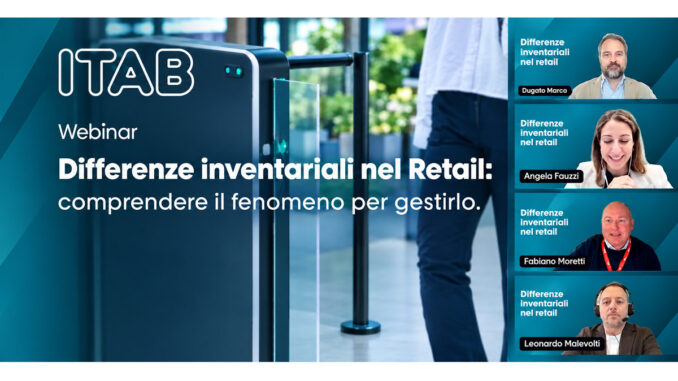
Loss Prevention in retail is evolving from a model focused on theft control towards a strategy that integrates store design, operational processes and data analysis. A webinar organised by ITAB Italy examined solutions for reducing inventory discrepancies in retail stores, with particular attention to large-scale distribution. From product placement and access management to Computer Vision, RFID and Artificial Intelligence, the discussion highlighted an approach to security that considers how the entire store operates.
Inventory Discrepancies: Why Theft Is Not the Only Cause
Inventory discrepancies are differences between the quantities of goods recorded in management systems and those physically available. They are not necessarily caused by theft committed by customers or employees.
Other causes include operational errors, incomplete records of waste and damaged goods, stock adjustments and incorrectly recorded internal transfers. These inefficiencies can generate direct losses while making it more difficult to identify merchandise theft.
Marco Dugato, Associate Professor at Università Cattolica del Sacro Cuore and Senior Researcher at Transcrime, emphasised the importance of identifying the causes of inventory losses before defining preventive measures.
The objective is to reduce the proportion of losses with unidentified causes by connecting inventory information, sales data and operational procedures. Prevention therefore becomes a cross-functional activity involving security, commercial management and store organisation.
Store Layout as a Loss Prevention Tool
The design of retail spaces can influence opportunities for theft.
During the webinar, Dugato referred to routine activity theory, according to which a crime becomes possible when three conditions coincide: a motivated offender, a suitable target and the absence of effective guardianship.
In retail environments, effective guardianship does not necessarily depend on the presence of security personnel. Spatial organisation, merchandise placement and surveillance technologies can also contribute to prevention.
From a design perspective, the relationship between store layout and security should therefore be assessed by considering product distribution, entrance and exit configurations, visibility across sales areas and checkout organisation.
This does not mean turning stores into environments dominated by physical barriers. Instead, protective measures should be integrated into store design and everyday operations, taking account of product characteristics and shopping behaviour.
High-Risk Products and Merchandise Protection in Large-Scale Retail
Loss Prevention challenges also reflect changes in organised retail theft.
Fabiano Moretti, Security Coordination Director at Finiper Canova Group, described incidents involving organised groups removing substantial quantities of products that are easy to transport and resell through unofficial channels.
Exposed product categories include electric toothbrush replacement heads, razor blades, coffee, nappies and canned tuna. More recently, Pokémon trading cards and Lego sets have also been identified as targets.
Unit value is therefore not the only factor determining risk. Portability, market demand and resale potential also play an important role.
Countermeasures include physical protection systems, such as protective mesh and display cabinets, video surveillance connected to checkout systems, and security labels applied directly by manufacturers.
The appropriate solution depends on the product and the specific risks identified. Periodic sales data analysis and targeted stocktaking can help retailers identify vulnerable product categories and implement tailored measures rather than applying the same protection strategy across the entire assortment.
Computer Vision and Self-Checkout Security
The introduction of automated technologies is also changing how retail stores are monitored.
Self-checkout areas allow customers to carry out transactions previously handled by store employees. Loss Prevention therefore requires tools capable of detecting anomalies and supporting staff during the checkout process.
According to Leonardo Malevolti, Retail Technology Manager at ITAB Italy, Computer Vision can identify anomalous behaviour and generate real-time alerts.
These systems can complement existing store technologies by connecting information from entrances, access gates and payment areas.
The principle is to move beyond managing individual devices separately. An integrated system can correlate events and data from different stages of the customer journey. Alerts support staff in assessing anomalies without automatically classifying every detected behaviour as an attempted theft.
RFID and Artificial Intelligence: Towards Predictive Loss Prevention
RFID technology uses radio-frequency tags and readers to identify products and collect information during merchandise handling and sales operations. When integrated with management systems, it can improve stock visibility and help identify inventory anomalies.
However, the development outlined by ITAB Italy focuses particularly on predictive Loss Prevention.
Through Artificial Intelligence and the combined analysis of environmental and behavioural data, systems could progressively move from detecting anomalies already occurring to assessing situations that may develop into security incidents.
This represents a direction for technological development rather than a capability that can already be assumed to exist in every retail environment.
For retailers, the value of this approach will depend on their ability to integrate information generated by devices with established operational procedures and staff intervention.
Retail Security: Design Principles for Architects and Retailers
Loss Prevention should be considered during the initial development of the store layout rather than addressed exclusively through additional devices installed after the fit-out.
Choosing appropriate solutions requires a combined assessment of product assortment, merchandise display, access points, checkout areas and operational procedures. Inventory data can help identify specific risks and guide targeted measures, from merchandise protection to spatial configuration.
Coordination between designers, retailers, security managers and technology providers makes it possible to integrate Loss Prevention measures without compromising commercial functionality or the usability of retail spaces.