
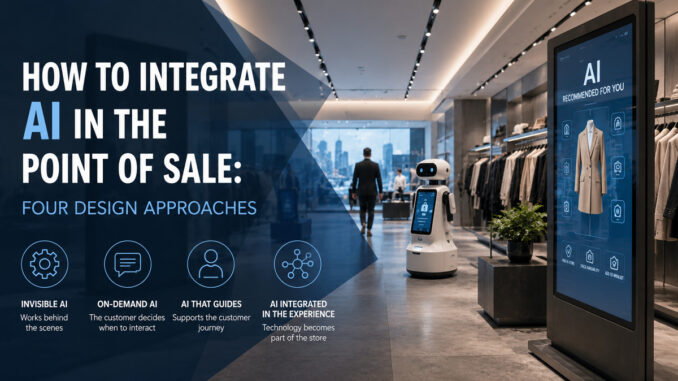
Artificial intelligence is becoming an increasingly visible part of the in-store environment, from virtual assistants and service robots to recommendation systems, interactive kiosks and tools designed to personalise the customer experience. The real challenge, however, is not simply introducing new technology. It is deciding how that technology should behave within the retail space.
Store design has traditionally shaped the shopping experience through materials, lighting, layout, furnishings and visual merchandising. AI introduces another design variable: the behaviour of technology.
It is no longer enough to decide where to position a robot, a virtual assistant or an AI-powered system. Designers must also determine when it should intervene, how it relates to the customer, what role it plays along the purchasing journey and, just as importantly, when it should remain in the background.
This shift moves the focus away from technology as a standalone feature and towards the way it is integrated into the point of sale. A highly advanced system may still prove ineffective if it interrupts the customer journey, constantly demands attention or encroaches on personal space. By contrast, technology designed to respond only when needed can support a more natural and coherent in-store experience.
When technology takes the initiative
This issue is examined in a study published in Recherche et Applications in Marketing, which explores the behaviour of sales robots and how consumers respond when technology initiates the interaction.
The research found that a robot approaching a customer without being invited may be perceived as more intrusive than one that remains available and waits to be addressed. This perception can reduce satisfaction with the store and make customers less likely to use the service.
The findings do not question the value of robotics in retail. Instead, they highlight an important design principle: the effectiveness of a technology also depends on when and how it enters into a relationship with the customer.
The full study, entitled “Robot, don’t approach me!” When a robot emulates a salesperson approaching in-store, is available on Sage Journals.
How AI reshapes the customer journey
Artificial intelligence in retail extends far beyond robots. It can appear through wayfinding systems, interactive kiosks, digital displays, virtual assistants, self-checkout solutions, sensors and tools that provide personalised information or recommendations.
Each of these elements affects the customer journey. A display that changes content when someone approaches, a virtual assistant that automatically recommends a product or a fully autonomous checkout system all influence how visitors navigate the store, make decisions and interact with their surroundings.
Store design therefore cannot be limited to providing a physical location or technical infrastructure for digital systems. It must also define how those systems behave, ensuring that they support the purchasing journey without interrupting it or unnecessarily competing with the role of store staff.
Four approaches to integrating AI into the point of sale
There is no single way to introduce artificial intelligence into a store. Existing retail projects and services reveal different strategies in which technology takes on a specific role according to the intended experience, the spatial organisation and the needs of the customer.
Invisible AI: technology working behind the scenes
At the Harmay store in Wuhan, technology does not seek direct contact with the customer. Instead, it operates primarily through internal processes. The automated product storage and handling system becomes part of the store’s architectural and logistical organisation.
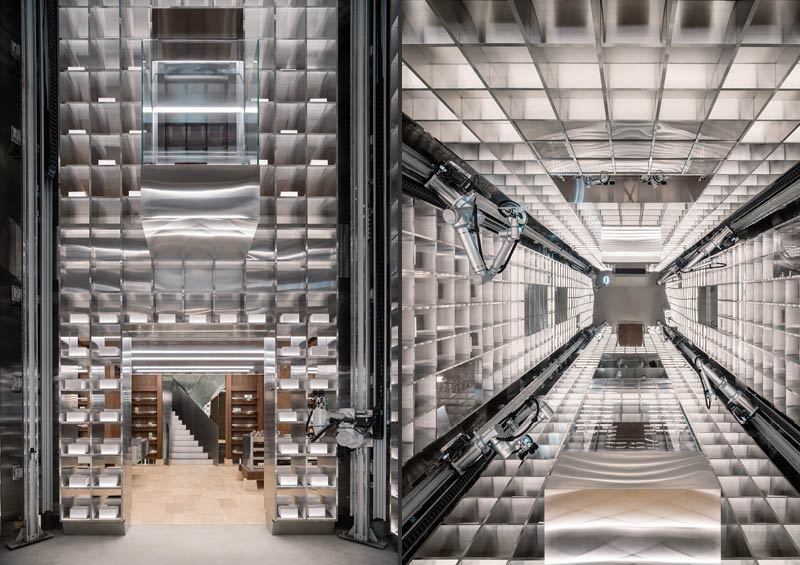
Customers are not required to interact with the system or alter their behaviour. They experience its effects indirectly through product availability, service efficiency and the organisation of the retail experience. The technology remains in the background and performs its role without demanding attention.
This model does not rely on making innovation visually prominent. Its value lies in the ability to coordinate automation, logistics and architecture without allowing the technological component to feel disconnected from the overall design.
On-demand AI: interaction starts with the customer
The Dina virtual assistant, featured among the technology-led services developed for retail innovation, follows a different model. The system does not automatically initiate the interaction. Instead, customers can request assistance through channels such as WhatsApp, Messenger or live chat.
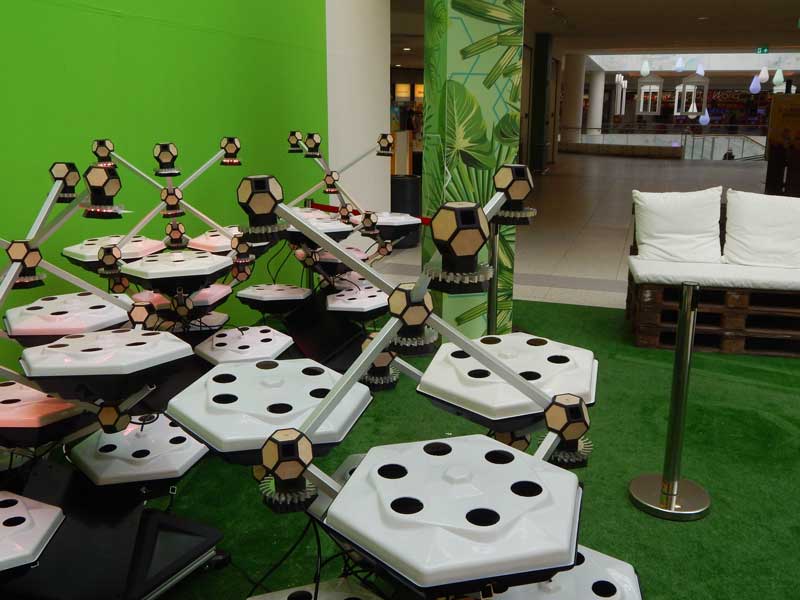
Technology remains available while allowing users to decide when to begin the conversation. This approach reflects the findings of the research into sales robots: when customers retain control over the interaction, the service may feel less intrusive and more respectful of their time.
The behaviour of the system therefore becomes part of the customer experience. Its value depends not only on the quality of the information it provides, but also on its ability to wait without repeatedly prompting the user to engage.
AI supporting the customer journey
At the Yamamay flagship store, technology contributes to an omnichannel experience connecting the physical point of sale with digital services. Digital personal shoppers, chatbots and mobile payment systems support customers across different stages of the purchasing journey.
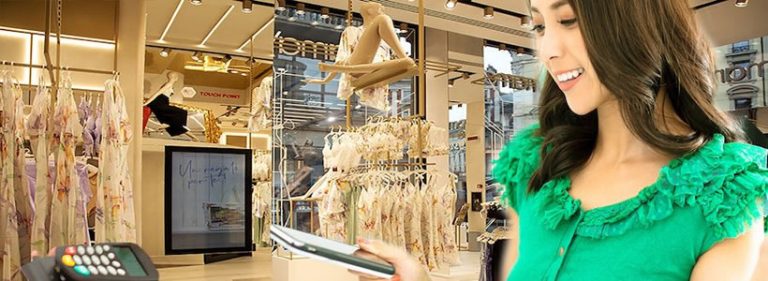
Technology is not limited to answering a specific question. It helps maintain continuity between product research, selection, assistance and payment. The system follows the customer journey and intervenes when it can simplify a decision or extend the services available within the store.
This approach requires close coordination between digital interfaces, spatial organisation and staff activity. Without a coherent design strategy, the presence of multiple channels may fragment the experience rather than make it more fluid.
AI embedded in the in-store experience
At Uncommon Store in Seoul, technology does not appear as an isolated service or a dedicated station. Sensors, cloud systems, machine learning and digital tools work together as part of the store’s overall operation and its contactless retail experience.
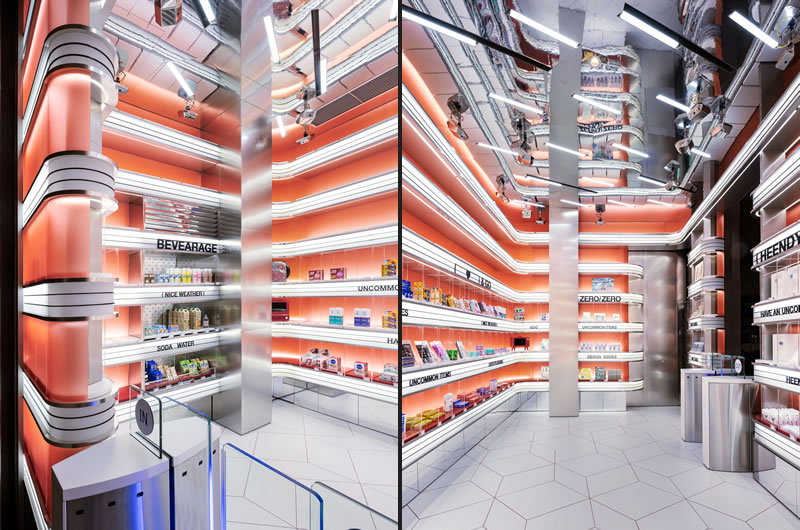
The store operates as an ecosystem in which digital infrastructure, access, product selection and payment are interconnected. AI is not an additional layer introduced after the architecture has been defined. It contributes directly to the way customers use the space.
In this case, technology becomes part of the service infrastructure. Its integration must be considered from the earliest stages of the project because it affects the layout, circulation, access points, payment process and the relationship between the physical environment and the digital platform.
AI does not replace design
These four approaches show that there is no universal solution for every point of sale. Artificial intelligence may operate behind the scenes, remain available on demand, support the customer journey or become fully embedded in the way the store functions.
In every case, however, its effectiveness depends on a design strategy that defines its role, position, timing and relationship with the public. A virtual assistant must know when to offer information and when to wait. A robot must be positioned without obstructing circulation. A display should attract attention without disrupting the reading of the space. An automated system must simplify the experience without making it more difficult to use.
These decisions do not concern software alone. They belong to store design and to the way architecture, people, services and technology coexist within the same retail experience.
The defining factor is therefore not the amount of technology introduced into the point of sale, but the way it is integrated and how it behaves towards the customer.
Artificial intelligence does not replace design. On the contrary, it makes design even more important. Every new technology changes the way people move through, understand and use a commercial environment. The project determines whether that presence becomes an added value or an element that disrupts the purchasing experience.
The challenge is not to create increasingly technological stores, but to integrate systems capable of intervening in the right way, at the right moment and in the right place.