
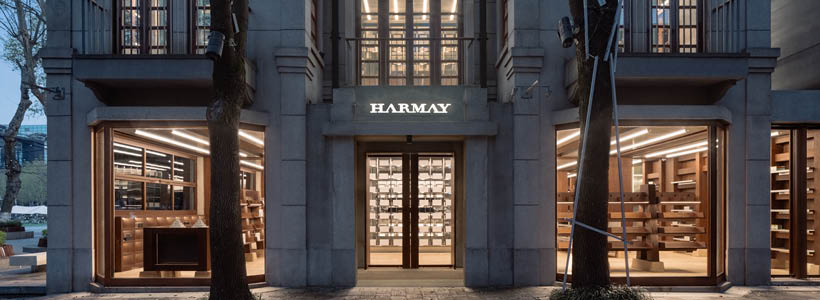
In the heart of Wuhan, Harmay occupies a 1940s building that once served as a bank within the city’s former Japanese concession. Designed by AIM Architecture, the project preserves the historic shell while introducing contemporary materials, custom furnishings and an automated storage system that defines the spatial organisation across three floors.
Covering 914 sqm, the store unfolds as a sequence of distinct environments rather than a single retail space. Stone, timber, metal and reflective surfaces create changing atmospheres, while a vertical automated storage system becomes the architectural element that connects the different levels.
An automated storage system integrated into the architecture
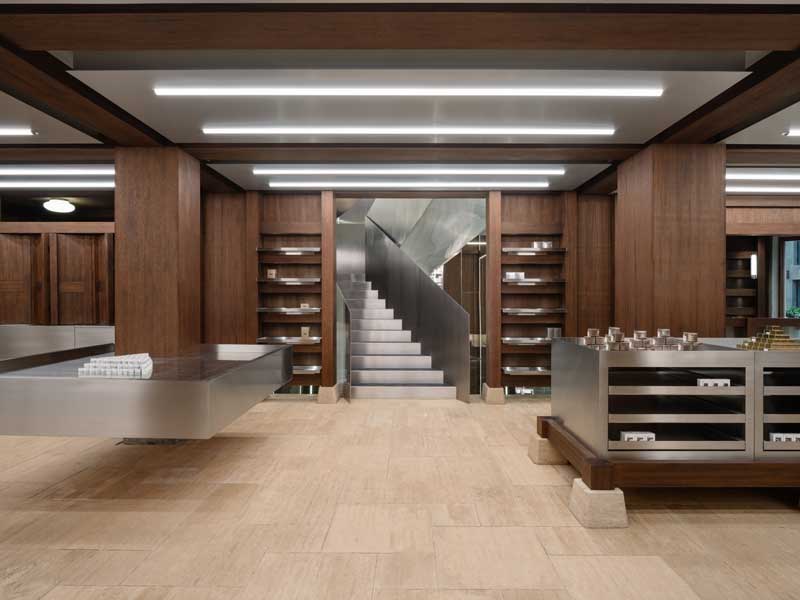
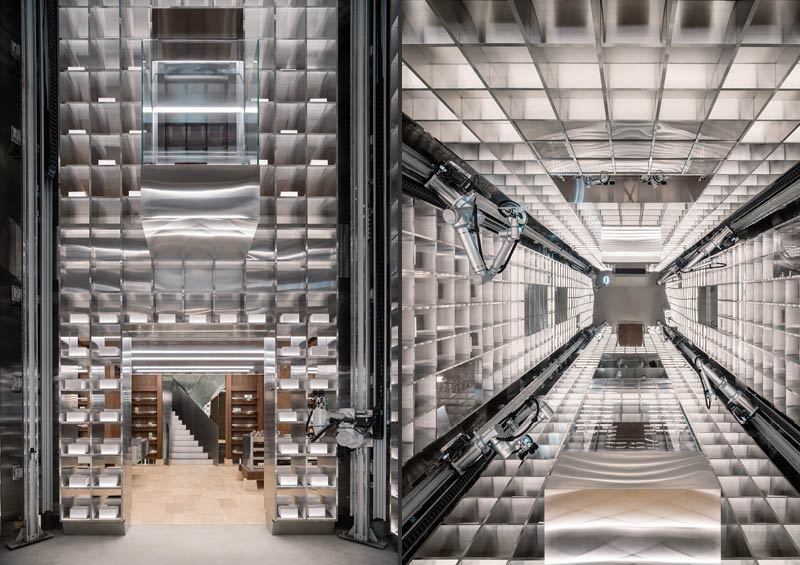
The automated vertical storage system extends through the full height of the building, visually connecting all three floors. Rather than being concealed in a service area, the technical infrastructure remains visible within the retail environment alongside the mirrored staircase that rises through the centre of the store.
The reflective staircase establishes visual continuity between the different levels while emphasising the presence of the automated system. Historic architecture and contemporary technology coexist within the same spatial composition, making logistics part of the architectural experience rather than a hidden operational function.
Customers are not expected to interact directly with the system or modify their behaviour. Instead, the technology operates discreetly in the background, supporting product storage and handling. Harmay therefore illustrates how automation can be integrated into retail architecture without becoming the focus of the customer experience. For a broader perspective, read our article on integrating AI into retail stores.
Three floors shaped by different material palettes
The store develops vertically, with each floor defined by its own architectural identity. Moving from one level to another introduces different materials, display solutions and spatial atmospheres, avoiding the repetition of a single retail concept.
Ground floor: stone, timber and metal
The ground floor combines rough stone flooring, solid timber display elements and metal components to create a robust material palette. Large stone blocks also function as display fixtures, reinforcing the warehouse-inspired character of the space.
The mirrored staircase and exposed steel elements introduce a more technological language while maintaining the automated storage system as the visual centrepiece. Architecture, logistics and merchandising remain clearly legible within the same environment.
First floor: a more domestic atmosphere
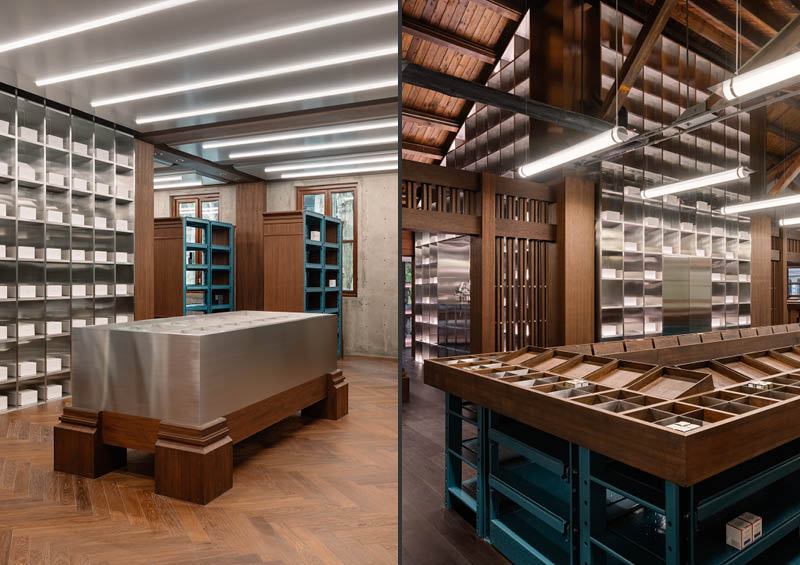
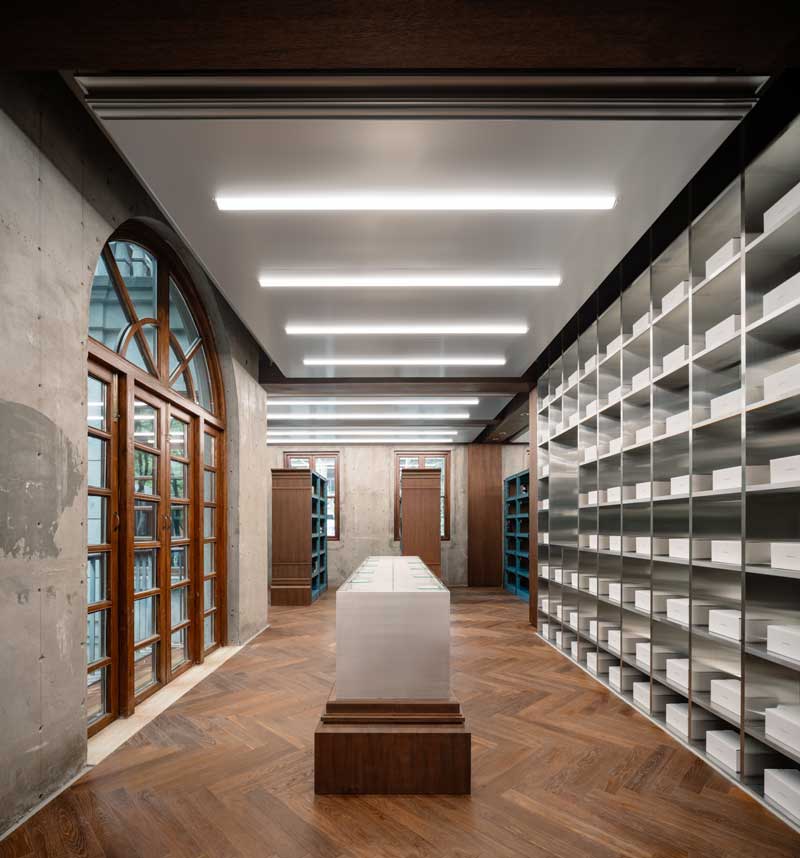
On the upper level, the atmosphere changes through herringbone timber flooring, traditional shelving and more intimate display proportions. The environment reflects the brand’s original identity while maintaining visual continuity with the rest of the project.
Anodised aluminium details and linear lighting preserve the dialogue with the technological components of the store. Warm materials and metallic finishes coexist without losing their individual character.
The rooftop combines retail and social space
The top floor adopts a more industrial character and extends onto an outdoor terrace, creating a hybrid environment where retail functions are combined with areas intended for social interaction and longer stays.
Together, the three floors create a continuous journey connected by the central storage system and a carefully balanced material palette. Vertical circulation becomes more than a functional requirement—it becomes an integral part of the retail experience.
Technology, layout and customer experience
At Harmay Wuhan, technology is not presented as an isolated interactive feature. Instead, it is embedded in the operation of the store, influencing spatial organisation, logistics and the relationship between products and architecture.
The automated storage system remains visible throughout the customer journey without interrupting it. Visitors continue to explore products and spaces while automation operates in parallel, supporting the retail environment without demanding attention.
This project demonstrates how store design can successfully integrate advanced technological infrastructure without allowing it to dominate the retail experience. Its value lies in improving the way the store operates while remaining fully aligned with the architectural concept.
Client: HARMAY
Location: Wuhan, China
Area: 914 sqm
Design: AIM ARCHITECTURE
Design Principals: Wendy Saunders & Vincent de Graaf
Project Architect: Jerry Guo
Interior Team: Dongkai Hu, Leslie Chen, Shawn Zhang
FF&E Team: Lili Cheng, Weisha
Photo credit: Wen Studio