
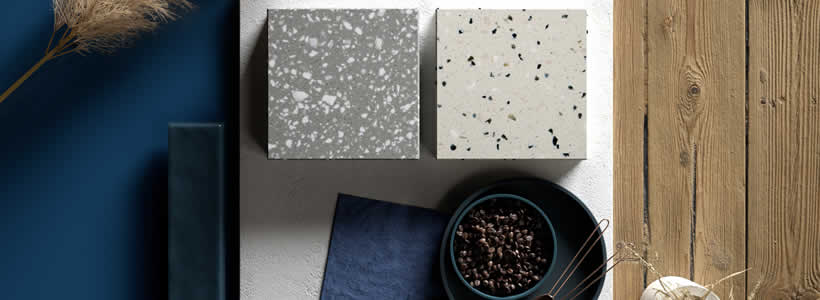
Terrazzo, rooted in the tradition of Venetian flooring and reinterpreted in contemporary design through speckled and irregular patterns, has also found its way into solid surface materials for interior applications.
HIMACS interprets this aesthetic through Terrazzo Classico and Terrazzo Grigio, two finishes developed for residential, commercial and public interiors, from wall cladding to functional surfaces.
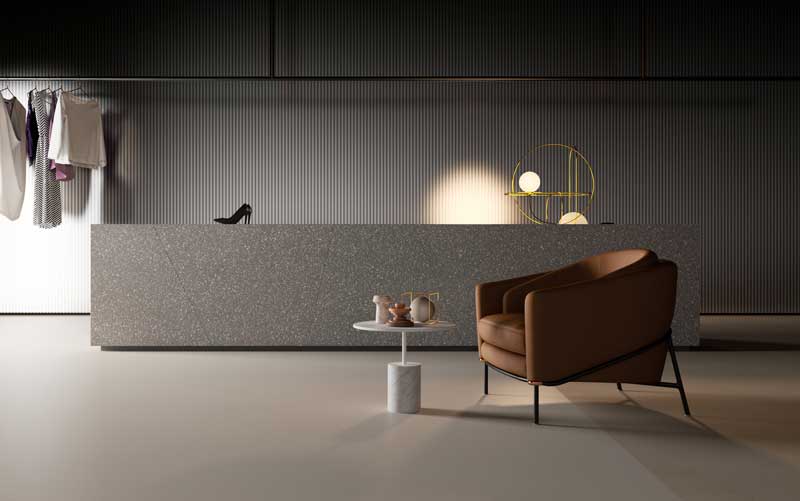
Terrazzo Classico and Terrazzo Grigio
The two finishes interpret the characteristic terrazzo pattern through different tonalities. Terrazzo Classico features a neutral palette, while Terrazzo Grigio introduces grey tones with a more industrial character.
The speckled, irregular and asymmetrical pattern transfers the visual language traditionally associated with terrazzo to elements of different scales, from walls to counters and work surfaces.
Applications for retail, hospitality and interior design
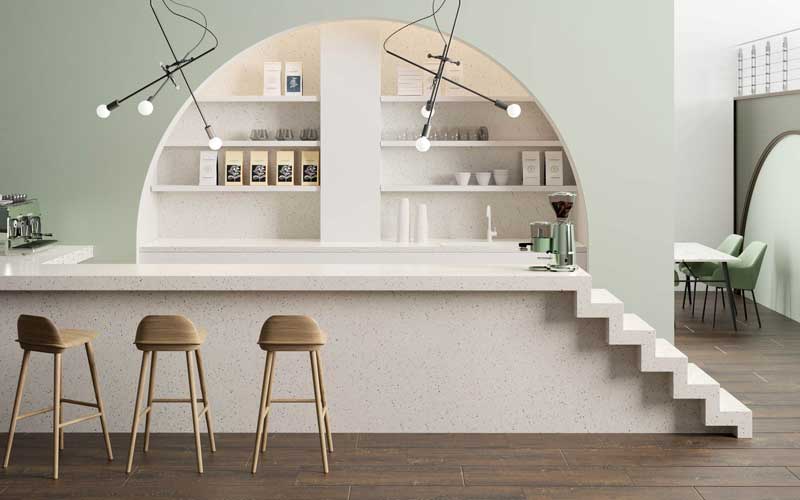
HIMACS Terrazzo can be used for wall cladding, counters, worktops, serving stations and table tops, making it suitable for shops, restaurants, bars and other public interiors.
In residential environments, the material can also be applied to shower areas, basins, kitchen worktops and islands. Its adaptability to elements with different functions makes it possible to establish material continuity throughout an interior.
A thermoformable, non-porous solid surface
HIMACS is a solid surface material made from minerals, acrylic and natural pigments. It can be thermoformed and fabricated to create continuous surfaces with visually inconspicuous joints and different geometries.
Its smooth, non-porous surface facilitates cleaning and maintenance, an important characteristic for applications in retail, hospitality and public environments. The material is also stain resistant and can be used for both vertical and horizontal surfaces.
Bringing the terrazzo pattern to continuous surfaces
Classico and Grigio transfer the fragmented appearance of terrazzo to a material that can be fabricated and thermoformed. The pattern can therefore extend from walls to furniture, counters and functional surfaces, providing a coordinated material language across different elements of an interior.
Photo credit: © Studio Podrini – HIMACS®
by AN Shopfitting Magazine no.159 ©