
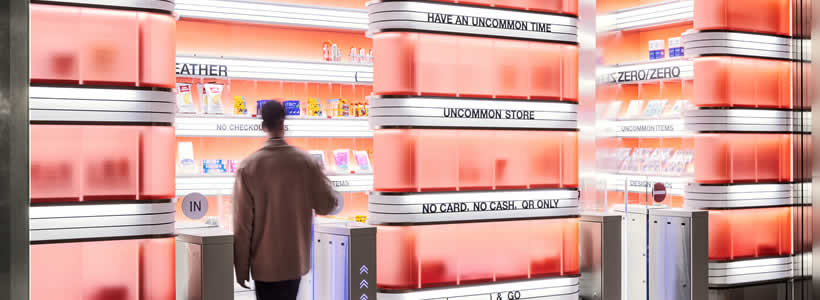
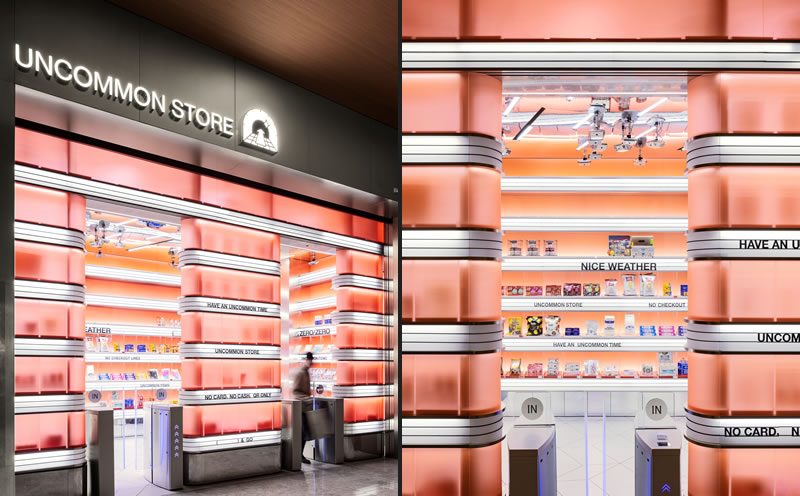
Located inside The Hyundai shopping centre in Seoul, Uncommon Store redefines the retail environment as a digital ecosystem where architecture, artificial intelligence and automated technologies operate as a single integrated system. Designed by Atelier Archi@Mosphere in collaboration with Hyundai Department Store Group, the 33 sqm concept store demonstrates how advanced technologies can become part of the architectural experience rather than simply supporting it.
Artificial intelligence, cloud computing, IoT devices and machine learning are not introduced as standalone features. Instead, they form the operational infrastructure that supports access, product management and customer interaction, reshaping the relationship between visitors and the retail environment.
A retail space designed as a digital ecosystem
Customers enter the store by scanning a QR code, while the entire shopping journey has been designed to minimise traditional interactions between shoppers and staff. Cloud computing, IoT devices, sensors and machine learning algorithms work together to manage access, product selection and purchasing.
Rather than being concentrated in a single digital station, these technologies are distributed throughout the retail environment. The result is an integrated system in which every component contributes to the overall shopping experience.
Uncommon Store is one of the projects featured in our article on integrating AI into retail stores, illustrating how digital technologies can become an essential part of architecture, customer service and spatial organisation.
AI, IoT and machine learning throughout the customer journey
Artificial intelligence is not represented by a visible robot or virtual assistant. Instead, it operates through sensors and machine learning systems that continuously collect and process information required for the store to function efficiently.
IoT devices monitor activities throughout the space, connecting customer access, product availability and user behaviour. Cloud technologies enable different systems to communicate seamlessly, while machine learning processes the data generated during the shopping journey.
Customers therefore move through a physical environment supported by an invisible digital infrastructure. Technology and architecture are conceived as complementary elements, making the retail experience possible through their integration.
Materials and layout define the concept store
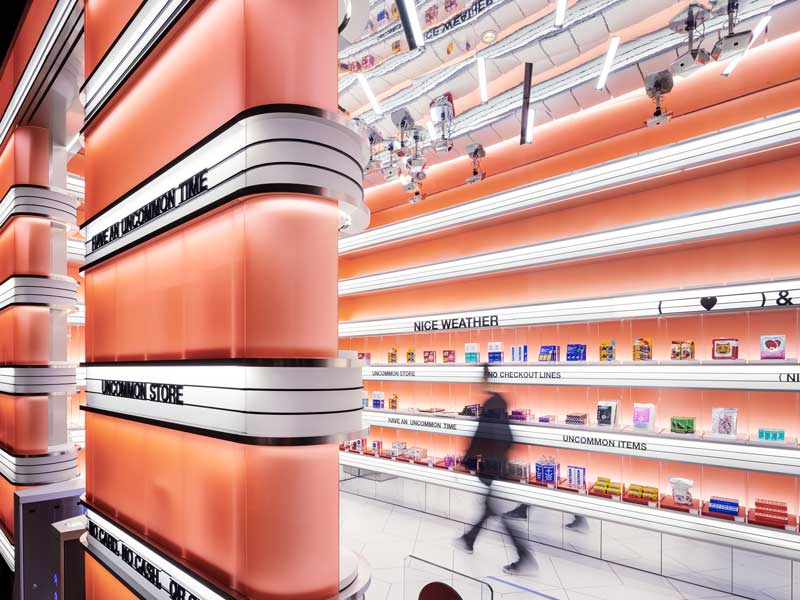
The architecture combines retro-futuristic references with a palette of peach tones, metallic finishes and large backlit bands that guide visitors through the retail environment. Together, these elements establish the project’s distinctive visual identity.
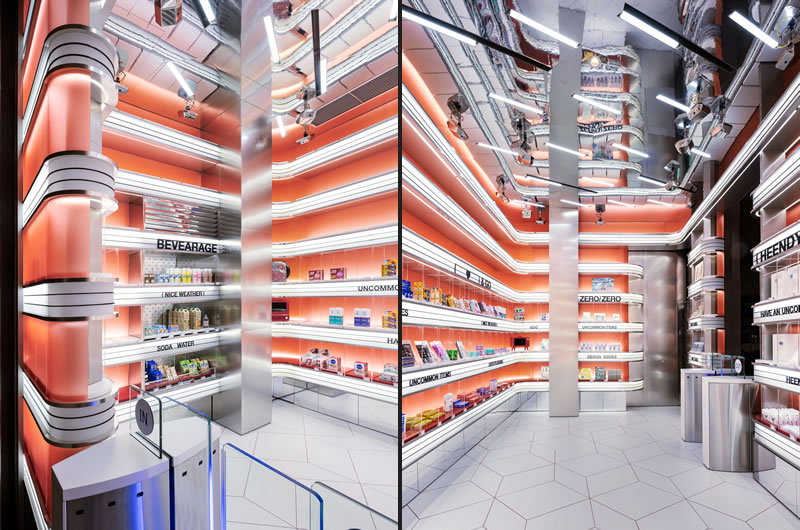
Walls alternate coloured surfaces with illuminated metallic panels that highlight the merchandise. Laminated ceiling finishes, acrylic details and linear lighting reinforce the technological character of the store while maintaining a coherent architectural language.
Display fixtures are arranged primarily along the perimeter, leaving the centre of the store open and easy to navigate. This layout improves spatial readability while allowing the distributed digital infrastructure to operate without interfering with customer circulation.
Technology as part of the retail experience
Technology at Uncommon Store is not presented as a collection of independent digital devices. Instead, it forms the operational backbone of the retail environment, influencing how customers enter the store, browse products and complete their purchases.
Artificial intelligence, cloud technologies and IoT systems were integrated into the architectural concept from the earliest design stages. As a result, digital infrastructure supports the customer journey without becoming visually dominant.
The project focuses on the relationship between architecture, services and technology rather than on technology itself. The store operates as a unified ecosystem where physical and digital components work together to shape the shopping experience.
A retail model built around digital integration
Despite its compact size, Uncommon Store anticipates many of the strategies now driving contemporary retail design. Artificial intelligence contributes not only to customer interaction but also to access management, product handling, data collection and operational efficiency.
The project demonstrates how store design is evolving beyond the integration of individual technologies towards the creation of complete digital ecosystems. Architecture, layout, materials and technological infrastructure are conceived together, allowing innovation to become an integral part of the retail environment.
Founded in 2011, Atelier Archi@Mosphere develops projects that combine architectural research with functional requirements. Each design begins with a careful understanding of the site’s physical characteristics, integrating technical expertise and multidisciplinary collaboration to create spaces tailored to their context.
Photo credit: Yongjoon Choi
by AN Shopfitting Magazine no.164 ©