
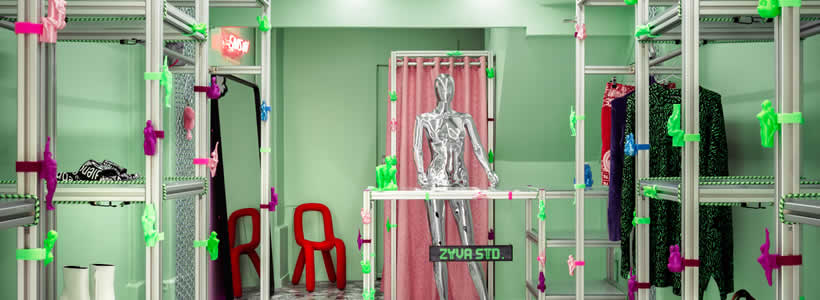
Snow Bunny Store Paris is a vintage fashion store designed by Zyva Studio for client Victoria Sapet in the 3rd arrondissement of Paris. Conceived by architect Anthony Authié, founder of Zyva Studio, the project reinterprets a 25 sqm retail space through a surreal interior narrative inspired by Alice in Wonderland. Specialised in vintage clothing from the 2000s, Snow Bunny Store combines modular display systems, immersive scenography and experimental materials to create a retail environment positioned between fashion boutique and theatrical installation.
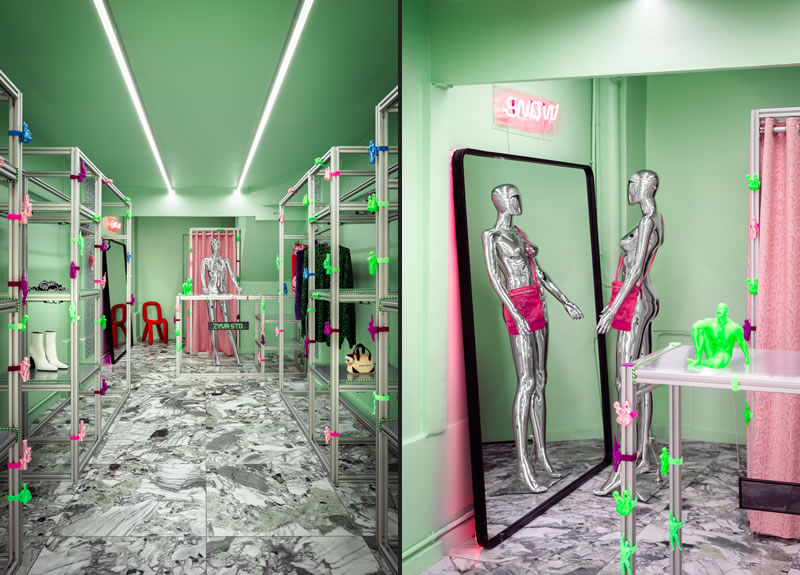
The retail concept translates Alice in Wonderland into an immersive fashion environment
The project draws directly from the visual universe of Lewis Carroll’s narrative, reinterpreting iconic characters and settings through architecture and interior design. Anthony Authié conceives the store as an imaginary environment where customers move through a surreal spatial sequence inspired by the White Rabbit, the Cheshire Cat and the psychedelic landscapes of Wonderland.
The interior composition combines green monochromatic surfaces, irregular textures and vivid chromatic accents to evoke an artificial and dreamlike nature. The marble-inspired finishes referencing oyster textures contribute to the perception of a distorted and immersive environment.
Rather than functioning as a neutral retail backdrop, the store becomes an active narrative device where furniture, materials and lighting contribute to the storytelling experience.
The small retail space uses modular systems to maximise flexibility and interaction
Developed within a compact 25 sqm floorplate, the project responds to both spatial and budget constraints through modular and easily dismantled display solutions. The layout organises the single-room environment into a progressive sequence of visual episodes that unfold as customers move through the store.
Metal display structures define the retail landscape while preserving openness and flexibility. The linear lighting elements suspended throughout the interior act like directional graphic gestures, guiding circulation and reinforcing the theatrical atmosphere of the project.
The spatial strategy transforms the limited footprint into an experiential environment where movement, perception and discovery become integral parts of the shopping experience.
3D-printed display elements introduce sculptural and functional retail details
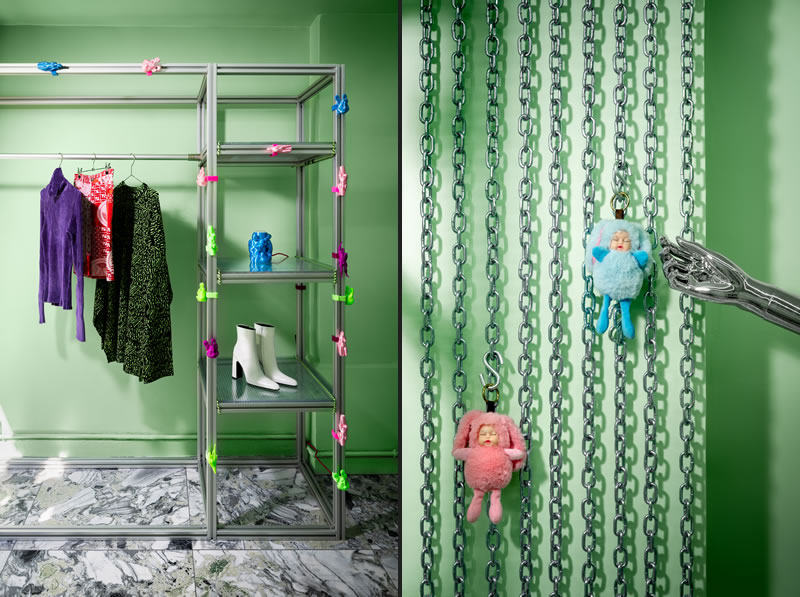
The modular metal racks are enriched with 3D-printed sculptural components inspired by the multicoloured flowers encountered by Alice in Wonderland. These decorative elements are not purely ornamental but also function as supports for necklaces, bracelets, rings and small accessories.
Each object contributes to the narrative identity of the store while expanding the functionality of the display system. The sculptural inserts behave almost like characters inhabiting the retail environment, reinforcing the project’s immersive and surreal dimension.
Additional wall-mounted chain installations introduce movement and sound into the interior. When touched, the suspended chains generate metallic collisions that create an interactive sensory layer within the customer experience while also serving as supports for handbags and caps.
Materials, colour and sound create a multisensory retail atmosphere
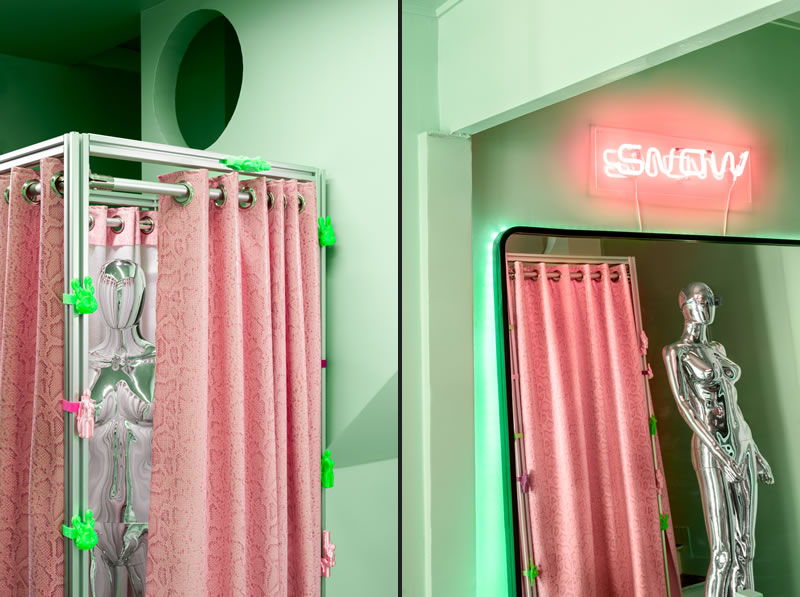
The project combines tactile materials, reflective surfaces and chromatic contrasts to construct a retail environment defined by sensory stimulation. Green walls establish the dominant visual identity of the space, while metallic lighting lines introduce a graphic and almost cinematic dimension.
The sound generated by moving chains and overlapping textures becomes part of the spatial composition, transforming the store into an environment activated through physical interaction. Furniture and display elements are conceived as living components capable of movement, sound and visual transformation.
At the rear of the store, the fitting room appears as a sculptural object positioned symmetrically within the layout. Wrapped in pink faux leather with a snake-skin effect, the changing booth contrasts sharply with the surrounding palette and introduces a more theatrical and immersive atmosphere.
Snow Bunny Store combines vintage fashion retail with experimental interior design
Through a combination of scenographic references, modular systems and sensory interactions, Snow Bunny Store develops a retail language that merges fashion, storytelling and spatial experimentation. The project reflects Zyva Studio’s approach to interior architecture, where retail environments become immersive narratives rather than purely commercial spaces.
The result is a contemporary vintage store that transforms a compact Parisian retail unit into an experiential environment shaped by movement, perception and surreal visual references.
Project Snow Bunny Store
Client Victoria Sapet
Location Paris, France
Architect Zyva Studio
Area 25 sqm
Photo Courtesy Yohann Fontaine
Zyva Studio | Anthony Authié
Anthony Authié, born in 1992, is a French architect based in Paris. An ENSAP Bordeaux graduate, he moved to Paris in 2018, where he joined an international architecture agency specialising in large-scale concepts. His architectural novel Baston de regards, a reflection on the professional experiences of a young architect, was published that same year by Parenthèses Editions.
He founded Zyva Studio in 2019 as a practice operating between architecture and design, and released Muscle, an essay exploring the relationship between the body and architecture. He later developed a series of works around Trans-Design, including furniture and global environments.
by AN Shopfitting Magazine no.166 ©